
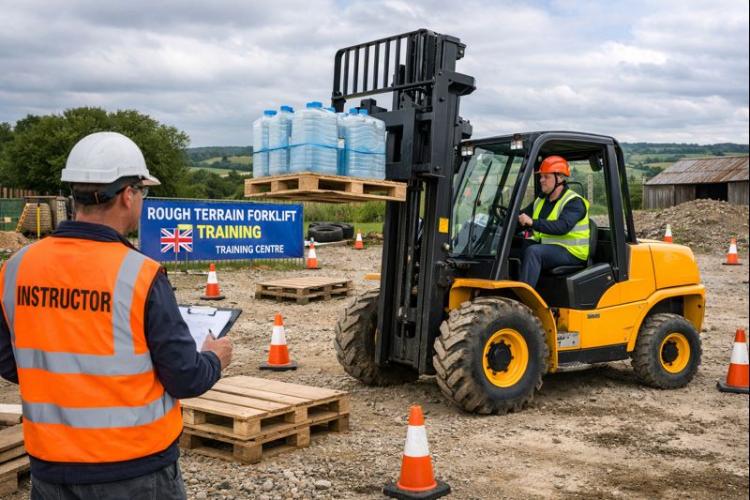
At Rough Terrain Forklift Training, we specialise in providing accredited operator development throughout the UK, focusing on safe handling practices for challenging outdoor conditions. Our programmes address the unique demands of uneven ground, variable gradients, construction settings, and agricultural environments, ensuring operators have the skills required for dependable and compliant machine operation.
Through structured instruction, practical demonstrations, and supervised driving tasks, learners gain the competence needed for real-world outdoor lifting operations while employers benefit from reduced incidents and improved operational efficiency.
What Key Skills Are Included in Rough Terrain Forklift Training?
Rough terrain forklift training teaches operators how to complete pre-use checks, understand load charts, and perform stable manoeuvres on uneven, sloped, or loose ground conditions.
Courses also cover visibility management, rough-surface travel techniques, correct use of 4WD systems, lifting and placing loads outdoors, and essential safety procedures such as secure parking and stability control. Operators gain hands-on practice using genuine rough terrain forklifts under guided supervision.
What Types of Rough Terrain Forklift Courses Can Be Taken?
Training centres offer several categories of rough terrain forklift instruction, including:
- Telescopic rough terrain forklifts – Suitable for construction sites requiring extra reach and lift height.
- Industrial-style rough terrain forklifts – Used for outdoor yards, forestry work, and farm operations.
- 4WD vertical mast rough terrain forklifts – Ideal for uneven agricultural surfaces and outdoor logistics.
- All-terrain pallet handling machines – Designed for outdoor pallet movements across unstable or loose ground.
How Much Does Rough Terrain Forklift Certification Cost?
Rough terrain forklift certification ranges between £150 and £300, depending on truck type, training level (novice, conversion, experienced), group size, and whether the course is delivered on-site or at a training centre.
Costs usually cover theoretical learning, practical operation, assessments, and accredited certification. Some providers may offer reduced rates for teams, repeat training, or multi-category bookings.
Contact Rough Terrain Forklift Training to receive a tailored quotation for your operators.
How Long Does Rough Terrain Forklift Training Take?
Beginner-level rough terrain forklift training generally lasts 3–5 days, covering essential skills, practical driving, and certification assessments.
Experienced operators and conversion training is shorter, often completed in 1–2 days, focusing on adapting to rough terrain equipment and mastering stability on uneven surfaces. Refresher sessions usually take one day and are recommended every 3–5 years. Courses requiring additional modules—such as advanced load-handling techniques or extended reach—may run longer.
Are Workers Expected to Hold Rough Terrain Forklift Certification?
Many employers require rough terrain forklift operators to hold recognised certification to meet PUWER and HSE expectations. Certified operators reduce accident risks, support safer outdoor lifting operations, and fulfil insurance and audit requirements for competent handling.
Sites routinely require accredited training for access to construction zones, farmyards, or outdoor loading areas, ensuring operators know correct operating routes, speed control, and ground-condition assessments.
What Safety Priorities Are Taught During Rough Terrain Forklift Courses?
Rough terrain forklift training emphasises key outdoor safety practices, including:
- Adherence to UK safety regulations – Understanding PUWER rules and site responsibilities.
- Load stability on uneven ground – Using lift angles, mast positioning, and load centres to prevent tip-overs.
- Safe route planning – Navigating slopes, ruts, gravel, mud, and outdoor blind spots.
- Daily machine inspections – Checking hydraulics, mast, tyres, forks, brakes, alarms, and traction systems.
- Environmental hazard awareness – Identifying risks such as soft ground, shifting loads, and weather-related instability.
- Emergency protocols – Knowing appropriate actions during mechanical failure or unsafe load conditions.
Are Flexible or On-Site Rough Terrain Forklift Courses Available?
Training options include on-site delivery for employers who have suitable training areas and a compliant rough terrain forklift available, allowing operators to learn directly in real working conditions.
Evening and weekend sessions are also offered for industries requiring shift-friendly training schedules, reducing operational disruption while ensuring all staff receive compliant instruction.
Can New Operators Enrol in Rough Terrain Forklift Training?
Rough terrain forklift training is fully appropriate for new starters with no prior forklift experience. Novice courses begin with core safety knowledge, truck familiarisation, and controlled manoeuvring on stable surfaces before progressing to more advanced tasks involving uneven ground and outdoor lifting.
Instructors monitor progress throughout the course, ensuring each learner develops confidence navigating slopes, managing load stability, and operating safely in unpredictable outdoor environments.
Contact Rough Terrain Forklift Training to arrange certification for your workforce.
Find More Info
Make sure you contact us today for a number of great Rough terrain forklift training services.
For more information on Rough terrain forklift training, fill in the contact form below to receive a free quote today.
★★★★★
Rough Terrain Forklift Training was delivered professionally with a strong focus on safety, stability, and real-site conditions. The trainer provided clear instruction and practical guidance throughout the course. Our operators gained confidence handling uneven ground and challenging loads. We would highly recommend this training.
Thomas Hardwicke
Greater London
★★★★★
The Rough Terrain Forklift Training course was well structured and highly practical. Both theory and hands-on sessions were tailored to our operational environment. The training significantly improved operator competence and safety awareness. We would confidently book this course again.
Isobel Cartwright
Greater London